The power of social networks


For years now we live with the confirmation of the importance of social networks and their impact on daily life. As with any other subject there are many and conflicting opinions on what is considered a social revolution. Millions, billions of people who daily exchange thoughts, opinions, images, emotions, anything that makes us feel alive and part of a community that filled our gaps. There are many theories behind social networks, in particular two are very fascinating, one who see social networks designed to be powerful tools for governments massive collection of information and monitoring of global sentiment, another who considers this platforms carriers of information but also manifest of social dissents, and for this to be kept under strict control.

I personally prefer a hypothesis that is placed in the middle, that treats social networks as powerful communication tools capable of reaching vast audiences planetary instantaneously and therefore is not very easy to tighter controls on each communication. This is the real concern of governments, losing control of a situation that could explode at any time to grow up to become unpredictable and unstoppable. Precisely this concern led to the following effects:

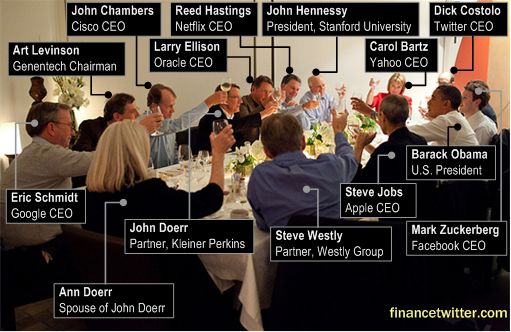
  • Government interference in the activities of companies that own the major social networking world. Rather than speak of interference, I believe we are facing with real collaboration and mutual exchange of favors. Who does not remember the dinner when President Obama hosted at the same table Zuckemberg, Steve Jobs, Larry Ellison of Oracle, Eric Schmidt of Google and many other prominent managers.  There is no doubt that companies like Google or Facebook today have the opportunity to obscure any account just beceause its behaviour is not compliant with their policies. Who has established this policies, who control the controllers? They manage search engine results pages (SERPs) and blogs search results all over the world. It seems Google has succumbed for example to the pressures of Indian censuring several blogs. It is easy to understand that this is the absolute power, to important to leave unmanaged, and Governments know it.
  • Adoption of tools for monitoring communications. Several times we heard news of the acquisition by governments of systems for monitoring communications. Each user watched, spied on by an intollerant big brother. The consequences are more or less serious depending on the nation to which they refer, we have an extensive casuistry, from preventive arrests to veritable tortures and murders. Regardless of race acquisition systems for monitoring, there are countless reports of this trend. Russia, China, Iran, in search of the system to control the voice of their peoples, the projection of their identity in cyberspace.
  • Implementation of methods for the direct analysis of social networks through active participation to the same. Agents, some times supported from Artificial Intelligent systems, that can monitor the overall sentiment on particular issues sometimes exerting a real influence. We have read several news regariding this topic, I can clear remember the interest manifested by Cia and FBI in the new media. They are a mine of information and it is really useful to adopt social networks like investigation instruments.

But what happens when all these approaches fail in intent?
There will be the final weapon, the “kill switch“, the censorship of the twenty-second century. A kill switch, also known as an e-stop is a security mechanism used to shut off in an emergency situation in the devices in which it can not be shut down in the usual manner. In this case the mechanism is the network itself isolating, and acting in this way it is possible to separate one nations from the rest of the world.
“Divide et impera”

So far we have been concerned about the potential of social networks, but obviously there is a downside. Just the huge media exposure of these new media can be a source of problems far from negligible. Social networks have literally swallowed whole populations by exposing them to new threats. The cyber crime, but also threats by hostiles government. In the first case, countless criminal organizations have used the network for attacks of all kinds, for social engineering attacks or to spread malware to steal financial information to the users. In the second case are the same Governments that infiltrating social networks to perform intellicence operations or to spread viruses developed for strategic objectives.

At this point one might wonder about the future of social networks. Will they grow with no brakes being able to exercise precise control of the masses, or we will it be less confidence on the trusting concept on which they are based?
In what direction society is moving?

Pierluigi Paganini

Pierluigi Paganini

Pierluigi Paganini is member of the ENISA (European Union Agency for Network and Information Security) Threat Landscape Stakeholder Group and Cyber G7 Group, he is also a Security Evangelist, Security Analyst and Freelance Writer. Editor-in-Chief at "Cyber Defense Magazine", Pierluigi is a cyber security expert with over 20 years experience in the field, he is Certified Ethical Hacker at EC Council in London. The passion for writing and a strong belief that security is founded on sharing and awareness led Pierluigi to find the security blog "Security Affairs" recently named a Top National Security Resource for US. Pierluigi is a member of the "The Hacker News" team and he is a writer for some major publications in the field such as Cyber War Zone, ICTTF, Infosec Island, Infosec Institute, The Hacker News Magazine and for many other Security magazines. Author of the Books "The Deep Dark Web" and “Digital Virtual Currency and Bitcoin”.

Recent Posts

SECURITY AFFAIRS MALWARE NEWSLETTER ROUND 84

Security Affairs Malware newsletter includes a collection of the best articles and research on malware…

26 minutes ago

Security Affairs newsletter Round 563 by Pierluigi Paganini – INTERNATIONAL EDITION

A new round of the weekly Security Affairs newsletter has arrived! Every week, the best…

58 minutes ago

Fintech firm Figure disclosed data breach after employee phishing attack

Fintech firm Figure confirmed a data breach after hackers used social engineering to trick an…

21 hours ago

U.S. CISA adds a flaw in BeyondTrust RS and PRA to its Known Exploited Vulnerabilities catalog

The U.S. Cybersecurity and Infrastructure Security Agency (CISA) adds a flaw in BeyondTrust RS and…

22 hours ago

Suspected Russian hackers deploy CANFAIL malware against Ukraine

A new alleged Russia-linked APT group targeted Ukrainian defense, government, and energy groups, with CANFAIL…

1 day ago

New threat actor UAT-9921 deploys VoidLink against enterprise sectors

A new threat actor, UAT-9921, uses the modular VoidLink framework to target technology and financial…

2 days ago

This website uses cookies.