There isn’t peace for social network platforms, priority target for cybercrime and governments, they represent a mine of data useful for business and espionage.
After the news of the LinkedIN hack, also Twitter have been successfully attacked by a group of hacktivist named LulzSec Reborn that has leaked user credentials of more of 10,000 accounts.
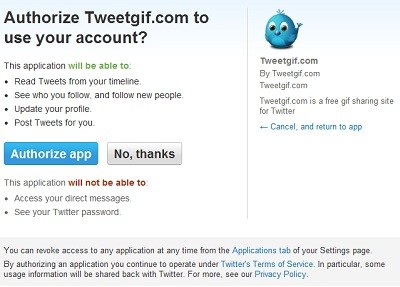
LulzSec Reborn appears to be composed by member of LulzSec and has recently attacked the MilitarySingles.com website. These compromised accounts used a third-party application, TweetGif, to share animated GIF files. Contrary to what it is possible to believe the data breach has exposed a huge quantity of data of the Twitter members, such us credentials, name, bios and locations, requested by TweetGif in the registration phase.
Part of the exposed data are also the secret tokes used by TweetGif to the cross authentication on Twitter account.
Well the hack raises a serious problem, security level ensured by third-party authentication processes that could expose data of the principal platform extending it surface of attack.
Does third-party companies adopt best practices for authentication processes? How do they grant the access to the application?
The third-party authentication process is realized implementing the open standard for authorization OAuth that allows users to share private resources stored on one site with another site without having to hand out their credentials, typically supplying username and password tokens instead.
Each token grants access to a specific site for specific resources and for a defined duration allowing a user to grant a third party site access to its information stored with another service provider, without sharing their access permissions or the full extent of their data.
It ‘clear that in those processes of oAuth authentication is considered essential that both parties implement security best practices, otherwise you run the risk of having increased the attack surface making it paradoxically more complex the prevention and detection of the attacks if they originate from trusted third parts.
Let’s remark that On April 23, 2009, a session fixation security flaw in the 1.0 protocol was announced. It affects the OAuth authorization flow in OAuth Core 1.0 Section 6. Version 1.0a of the OAuth Core protocol was issued to address this issue. OAuth 2.0 is the next evolution of the OAuth protocol and is not backward compatible with OAuth 1.0. OAuth 2.0 focuses on client developer simplicity while providing specific authorization flows for web applications, desktop applications, mobile phones, and living room devices.
Following the List of OAuth Service Providers, as it is possible to note Twitter is implementing the 1.0a version.
Which are the consequences of the hack?
Let’s distinguish the emotional factor from the actual risks faced by the users. The data leak has given a negative image of the Twitter company, in a time when the reliability of social networks in terms of security is at historic lows. Regarding the risks faced by the users, these accounts can be used to spam over 10000 of compromised twitter accounts.
The exposure of the consumer key and consumer secret key from a popular third-party Twitter application make a spammer hard to be detectable. The solution to the problem is revoke the grant to the exploited third part app, in this case a TweetGif User, need to go to settings > apps > deauthorize app. #TweetGif. “Revoke Access”.
Pierluigi Paganini
Fintech firm Figure confirmed a data breach after hackers used social engineering to trick an…
The U.S. Cybersecurity and Infrastructure Security Agency (CISA) adds a flaw in BeyondTrust RS and…
A new alleged Russia-linked APT group targeted Ukrainian defense, government, and energy groups, with CANFAIL…
A new threat actor, UAT-9921, uses the modular VoidLink framework to target technology and financial…
Attackers quickly targeted BeyondTrust flaw CVE-2026-1731 after a PoC was released, enabling unauthenticated remote code…
Google says nation-state actors used Gemini AI for reconnaissance and attack support in cyber operations.…
This website uses cookies.