Malware

Experts from Bleeping Computer spotted a new Cryptomix Ransomware variant

Security experts spotted a new variant of the CryptoMix ransomware that uses a different extension (.FILE) and a new set of contact emails.

Security experts from BleepingComputer discovered a new variant of the CryptoMix ransomware that uses a different extension (.FILE)  to append to the file names of the encrypted files and uses new contact emails.

For example, a file encrypted by this variant of ransomware has an encrypted file name of 0D0A516824060636C21EC8BC280FEA12.FILE.

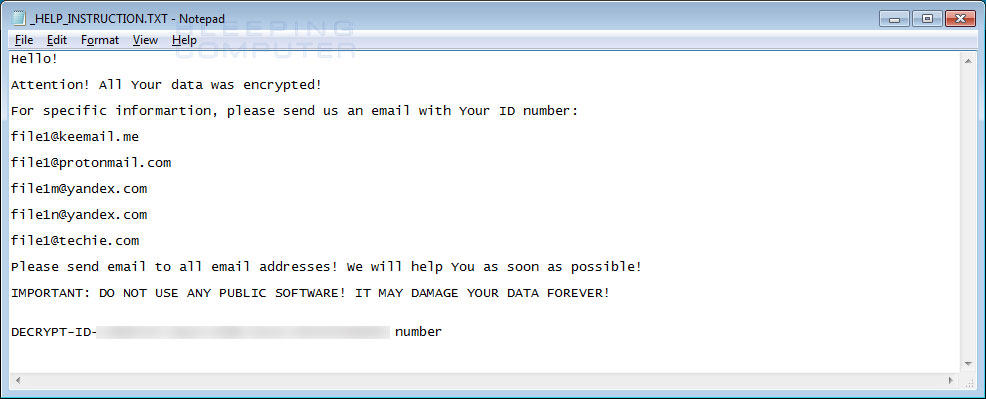
Experts discovered that this variant uses the same encryption methods of previous ones, the ransomware uses the same ransom note is still named _HELP_INSTRUCTION.TXT, but the contact emails to receive the payment instructions are file1@keemail.me, file1@protonmail.com, file1m@yandex.com, file1n@yandex.com, and file1@techie.com.

Further details and the IoCs are included in the post published on Bleeping Computer.

“As we are always looking for weaknesses, if you are a victim of this variant and decide to pay the ransom, please send us the decryptor so we can take a look at it. You can also discuss or receive support for Cryptomix ransomware infections in our dedicated Cryptomix Help & Support Topic.” wrote Lawrence Abrams.

Below the list of recommendations provided by the experts to protect your system from ransomware attacks.

  • Backup, Backup, Backup!
  • Do not open attachments if you do not know who sent them.
  • Do not open attachments until you confirm that the person actually sent you them.
  • Enable the showing of file extensions.
  • If an attachment ends with .js, .vbs, .exe, .scr, or .bat, do not open them for any reason.
  • Scan attachments with tools like VirusTotal.
  • Make sure all Windows updates are installed as soon as they come out! Also make sure you update all programs, especially Java, Flash, and Adobe Reader. Older programs contain security vulnerabilities that are commonly exploited by malware distributors. Therefore it is important to keep them updated.
  • Make sure you use have some sort of security software installed that uses behavioral detections or white list technology. White listing can be a pain to train, but if your willing to stock with it, could have the biggest payoffs.
  • Use hard passwords and never reuse the same password at multiple sites.

If you are interested in Indicators of Compromise give a look at the blog post.

[adrotate banner=”9″] [adrotate banner=”12″]

Pierluigi Paganini

(Security Affairs – Cryptomix Ransomware, cybercrime)

[adrotate banner=”5″]

[adrotate banner=”13″]

Pierluigi Paganini

Pierluigi Paganini is member of the ENISA (European Union Agency for Network and Information Security) Threat Landscape Stakeholder Group and Cyber G7 Group, he is also a Security Evangelist, Security Analyst and Freelance Writer. Editor-in-Chief at "Cyber Defense Magazine", Pierluigi is a cyber security expert with over 20 years experience in the field, he is Certified Ethical Hacker at EC Council in London. The passion for writing and a strong belief that security is founded on sharing and awareness led Pierluigi to find the security blog "Security Affairs" recently named a Top National Security Resource for US. Pierluigi is a member of the "The Hacker News" team and he is a writer for some major publications in the field such as Cyber War Zone, ICTTF, Infosec Island, Infosec Institute, The Hacker News Magazine and for many other Security magazines. Author of the Books "The Deep Dark Web" and “Digital Virtual Currency and Bitcoin”.

Recent Posts

Fintech firm Figure disclosed data breach after employee phishing attack

Fintech firm Figure confirmed a data breach after hackers used social engineering to trick an…

15 hours ago

U.S. CISA adds a flaw in BeyondTrust RS and PRA to its Known Exploited Vulnerabilities catalog

The U.S. Cybersecurity and Infrastructure Security Agency (CISA) adds a flaw in BeyondTrust RS and…

17 hours ago

Suspected Russian hackers deploy CANFAIL malware against Ukraine

A new alleged Russia-linked APT group targeted Ukrainian defense, government, and energy groups, with CANFAIL…

21 hours ago

New threat actor UAT-9921 deploys VoidLink against enterprise sectors

A new threat actor, UAT-9921, uses the modular VoidLink framework to target technology and financial…

1 day ago

Attackers exploit BeyondTrust CVE-2026-1731 within hours of PoC release

Attackers quickly targeted BeyondTrust flaw CVE-2026-1731 after a PoC was released, enabling unauthenticated remote code…

2 days ago

Google: state-backed hackers exploit Gemini AI for cyber recon and attacks

Google says nation-state actors used Gemini AI for reconnaissance and attack support in cyber operations.…

2 days ago

This website uses cookies.