According to cloud security firm Avanan, one of the detection mechanisms in Office 365 involves natural language processing to identify the content of the messages typically used in malicious emails.
For example, an email including the words “Apple” or “Microsoft” that are not sent from legitimate domains, or messages referencing user accounts, password resets or financial requests are flagged as malicious.
Experts from Avanan discovered phishing campaigns using emails in which some of the content is set to be displayed with zero-size font using <span style=”FONT-SIZE: 0px”>, for this reason, they dubbed the technique ZeroFont.
“Recently, we have been seeing a number of phishing attacks using a simple strategy to get their blatant email spoofs past Microsoft’s phishing scans. The tactic, which we are calling ZeroFont, involves inserting hidden words with a font size of zero that are invisible to the recipient in order to fool Microsoft’s natural language processing.” reads the analysis published by Avanan.
The email appears to the recipient as normal, but Microsoft’s filters are able to analyze also the text having a font size of “0”.
Summarizing, while the user sees a classic phishing content like this:
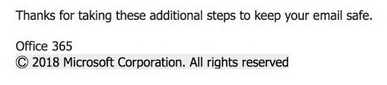
Microsoft’s filter will see the overall text including words written with “FONT-SIZE: 0px” attribute. This text, of course, doesn’t appear as a malicious content:
“Microsoft can not identify this as a spoofing email because it cannot see the word ‘Microsoft’ in the un-emulated version. Essentially, the ZeroFont attack makes it possible to display one message to the anti-phishing filters and another to the end user,” Avanan’s Yoav Nathaniel said in a blog post.
Natural language processing is essential to prevent phishing attacks, but a technique like ZeroFont demonstrated that attackers can bypass filters with a trick.
In the past, other techniques were devised to bypass anti-phishing filters, for example, the Punycode phishing attack, the baseStriker phishing attack, the Unicode phishing attack, and the Hexadecimal Escape Characters phishing attack.
| [adrotate banner=”9″] | [adrotate banner=”12″] |
(Security Affairs – ZeroFont phishing attack, cybercrime)
[adrotate banner=”5″]
[adrotate banner=”13″]
Fintech firm Figure confirmed a data breach after hackers used social engineering to trick an…
The U.S. Cybersecurity and Infrastructure Security Agency (CISA) adds a flaw in BeyondTrust RS and…
A new alleged Russia-linked APT group targeted Ukrainian defense, government, and energy groups, with CANFAIL…
A new threat actor, UAT-9921, uses the modular VoidLink framework to target technology and financial…
Attackers quickly targeted BeyondTrust flaw CVE-2026-1731 after a PoC was released, enabling unauthenticated remote code…
Google says nation-state actors used Gemini AI for reconnaissance and attack support in cyber operations.…
This website uses cookies.