• Home
  • Cyber Crime
  • Cyber warfare
  • APT
  • Data Breach
  • Deep Web
  • Digital ID
  • Hacking
  • Hacktivism
  • Intelligence
  • Internet of Things
  • Laws and regulations
  • Malware
  • Mobile
  • Reports
  • Security
  • Social Networks
  • Terrorism
  • ICS-SCADA
  • POLICIES
  • Contact me
MUST READ

JPCERT/CC Reports Widespread Exploitation of Array Networks AG Gateway Vulnerability

 | 

BRICKSTORM backdoor exposed: CISA warns of advanced China-backed intrusions

 | 

U.S. CISA adds a new an OpenPLC ScadaBR flaw to its Known Exploited Vulnerabilities catalog

 | 

Marquis data breach impacted more than 780,000 individuals

 | 

ASUS confirms vendor breach as Everest gang leaks data, claims ArcSoft and Qualcomm

 | 

Cloudflare mitigates record 29.7 Tbps DDoS attack by the AISURU botnet

 | 

King Addons flaw lets anyone become WordPress admin

 | 

University of Pennsylvania and University of Phoenix disclose data breaches

 | 

Researchers spotted Lazarus’s remote IT workers in action

 | 

India mandates SIM-linked messaging apps to fight rising fraud

 | 

U.S. CISA adds Android Framework flaws to its Known Exploited Vulnerabilities catalog

 | 

MuddyWater strikes Israel with advanced MuddyViper malware

 | 

'Korea’s Amazon' Coupang discloses a data breach impacting 34M customers

 | 

Google’s latest Android security update fixes two actively exploited flaws

 | 

Law enforcement shuts down Cryptomixer in major crypto crime takedown

 | 

Australian man jailed for 7+ years over airport and in-flight Wi-Fi attacks

 | 

Emerging Android threat ‘Albiriox’ enables full On‑Device Fraud

 | 

U.S. CISA adds an OpenPLC ScadaBR flaw to its Known Exploited Vulnerabilities catalog

 | 

SECURITY AFFAIRS MALWARE NEWSLETTER ROUND 73

 | 

Security Affairs newsletter Round 552 by Pierluigi Paganini – INTERNATIONAL EDITION

 | 
  • Home
  • Cyber Crime
  • Cyber warfare
  • APT
  • Data Breach
  • Deep Web
  • Digital ID
  • Hacking
  • Hacktivism
  • Intelligence
  • Internet of Things
  • Laws and regulations
  • Malware
  • Mobile
  • Reports
  • Security
  • Social Networks
  • Terrorism
  • ICS-SCADA
  • POLICIES
  • Contact me
  • Home
  • Breaking News
  • Data Breach
  • Experian API exposed credit scores of tens of millions of Americans

Experian API exposed credit scores of tens of millions of Americans

Pierluigi Paganini May 03, 2021

Experian API exposed credit scores of tens of millions of Americans due to a weakness with a partner website.

Anyone was able to look up the credit score of tens of millions of Americans just by providing their name and mailing address.

The issue was reported to KrebsOnSecurity by the independent security researcher Bill Demirkapi, who discovered the data exposure while shopping around for student loan vendors online.

“Demirkapi encountered one lender’s site that offered to check his loan eligibility by entering his name, address and date of birth. Peering at the code behind this lookup page, he was able to see it invoked an Experian Application Programming Interface or API — a capability that allows lenders to automate queries for FICO credit scores from the credit bureau.” reported KrebsOnSecurity.

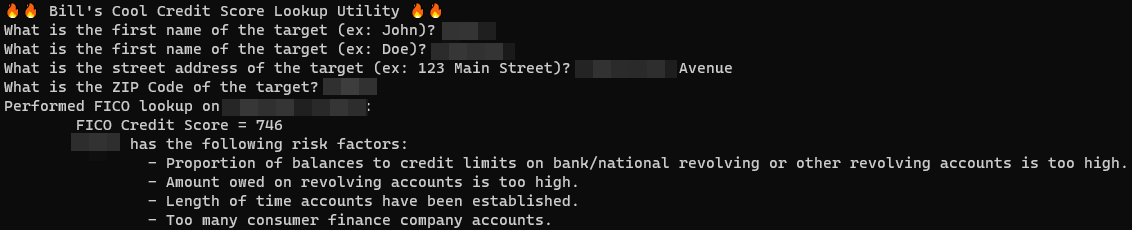
The researchers discovered that the Experian API could be used without authentication, he also noticed that by providing a “date of birth” composed of all zeros it is possible to access a person’s credit score. He also developed a command-line tool to automate the lookups, which he named “Bill’s Cool Credit Score Lookup Utility.”

KrebsOnSecurity successfully tested Demirkapi’s tool.

What can an attacker do with access to Experian's API? An attacker could easily enumerate the millions of public records available that contain a name/address (voting, property, etc) and find the credit information of those individuals. Remember, these are soft pulls. 6/n

— Bill Demirkapi (@BillDemirkapi) April 30, 2021

The APT also returns for each consumer up to four “risk factors,” which are sensitive information about his habits.

Demirkapi did not share with Experian the name of the service that was exposing the API because he suspects there may be thousands of companies using the same API, and that many of those services could be similarly leaking access to Experian’s consumer data.

“If we let them know about the specific endpoint, they can just ban/work with the loan vendor to block these requests on this one case, which doesn’t fix the systemic problem,” Demirkapi told to KrebOnSecurity.

Nevertheless, after being contacted by this reporter Experian figured out on its own which lender was exposing their API; Demirkapi said that vendor’s site now indicates the API access has been disabled.

“We have been able to confirm a single instance of where this situation has occurred and have taken steps to alert our partner and resolve the matter,” Experian said in a written statement. “While the situation did not implicate or compromise any of Experian’s systems, we take this matter very seriously. Data security has always been, and always will be, our highest priority.”

Demirkapi said he’s disappointed that Experian did exactly what he feared they would do.

“They found one endpoint I was using and sent it into maintenance mode,” he said. “But this doesn’t address the systemic issue at all.”

Leaky and poorly-secured APIs like the one Demirkapi found are the source of much mischief in the hands of identity thieves. Earlier this month, auto insurance giant Geico disclosed that fraudsters abused a bug in its site to steal drivers license numbers from Americans.

Geico said the data was used by thieves involved in fraudulently applying for unemployment insurance benefits. Many states now require drivers license numbers as a way of verifying an applicant’s identity.

In 2013, KrebsOnSecurity broke the news about an identity theft service in the underground that programmatically pulled sensitive consumer credit data directly from a subsidiary of Experian. That service was run by a Vietnamese hacker who’d told the Experian subsidiary he was a private investigator. The U.S. Secret Service later said the ID theft service “caused more material financial harm to more Americans than any other.”

If you want to receive the weekly Security Affairs Newsletter for free subscribe here.

Follow me on Twitter: @securityaffairs and Facebook

[adrotate banner=”9″][adrotate banner=”12″]

Pierluigi Paganini

(SecurityAffairs – hacking, Experian API)

[adrotate banner=”5″]

[adrotate banner=”13″]


facebook linkedin twitter

Cybersecurity cybersecurity news data leak Experian Hacking hacking news information security news Pierluigi Paganini Security Affairs Security News

you might also like

Pierluigi Paganini December 05, 2025
BRICKSTORM backdoor exposed: CISA warns of advanced China-backed intrusions
Read more
Pierluigi Paganini December 04, 2025
U.S. CISA adds a new an OpenPLC ScadaBR flaw to its Known Exploited Vulnerabilities catalog
Read more

leave a comment

newsletter

Subscribe to my email list and stay
up-to-date!

    recent articles

    JPCERT/CC Reports Widespread Exploitation of Array Networks AG Gateway Vulnerability

    Uncategorized / December 05, 2025

    BRICKSTORM backdoor exposed: CISA warns of advanced China-backed intrusions

    Intelligence / December 05, 2025

    U.S. CISA adds a new an OpenPLC ScadaBR flaw to its Known Exploited Vulnerabilities catalog

    Hacking / December 04, 2025

    Marquis data breach impacted more than 780,000 individuals

    Data Breach / December 04, 2025

    ASUS confirms vendor breach as Everest gang leaks data, claims ArcSoft and Qualcomm

    Data Breach / December 04, 2025

    To contact me write an email to:

    Pierluigi Paganini :
    pierluigi.paganini@securityaffairs.co

    LEARN MORE

    QUICK LINKS

    • Home
    • Cyber Crime
    • Cyber warfare
    • APT
    • Data Breach
    • Deep Web
    • Digital ID
    • Hacking
    • Hacktivism
    • Intelligence
    • Internet of Things
    • Laws and regulations
    • Malware
    • Mobile
    • Reports
    • Security
    • Social Networks
    • Terrorism
    • ICS-SCADA
    • POLICIES
    • Contact me

    Copyright@securityaffairs 2024

    We use cookies on our website to give you the most relevant experience by remembering your preferences and repeat visits. By clicking “Accept All”, you consent to the use of ALL the cookies. However, you may visit "Cookie Settings" to provide a controlled consent.
    Cookie SettingsAccept All
    Manage consent

    Privacy Overview

    This website uses cookies to improve your experience while you navigate through the website. Out of these cookies, the cookies that are categorized as necessary are stored on your browser as they are essential for the working of basic functionalities...
    Necessary
    Always Enabled
    Necessary cookies are absolutely essential for the website to function properly. This category only includes cookies that ensures basic functionalities and security features of the website. These cookies do not store any personal information.
    Non-necessary
    Any cookies that may not be particularly necessary for the website to function and is used specifically to collect user personal data via analytics, ads, other embedded contents are termed as non-necessary cookies. It is mandatory to procure user consent prior to running these cookies on your website.
    SAVE & ACCEPT