Pierluigi Paganini
 August 21, 2026

Researchers at the University of Massachusetts Amherst demonstrated at USENIX Security 2026 in Baltimore that expired Visa contactless credit cards can complete real purchases, including transactions at live retail and grocery merchants, by exploiting a gap in how the payment protocol handles expiration dates. The paper is titled “Zombie Cards Back Online: Reviving Expired Credit Cards for Contactless Payments,” and the name is accurate.
Raja Hasnain Anwar, Gerard DeCunha, and Muhammad Taqi Raza built the attack around a structural weakness in EMV, the contactless payment protocol used by Visa, Mastercard, American Express, and Discover.
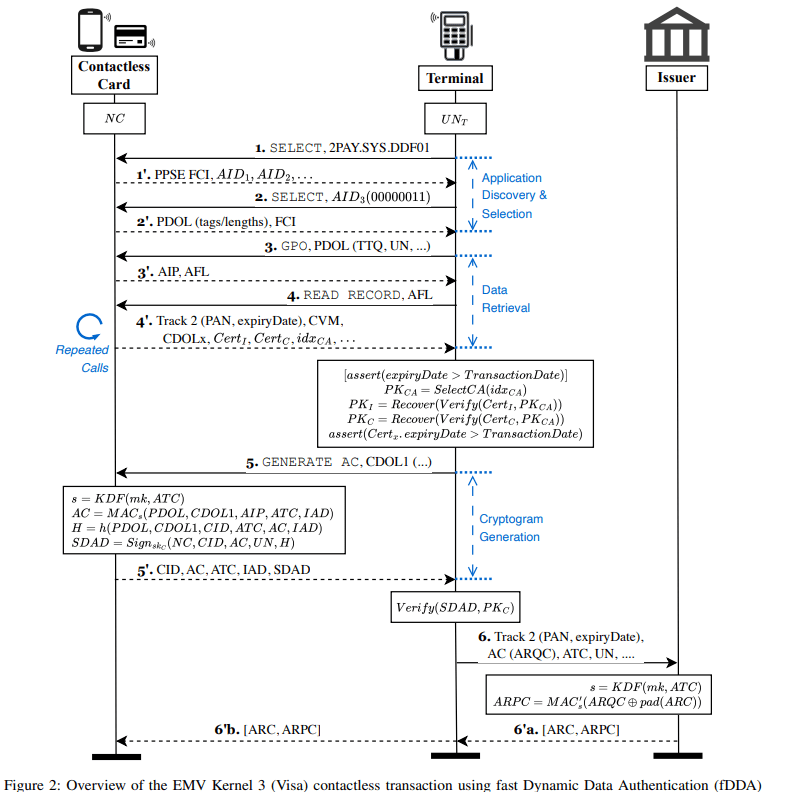
“A central source of fragility is that the EMV contactless protocol is a selectively authenticated transaction flow. Many data objects are exchanged in plaintext between the card and terminal [2], and only a subset is later bound to cryptographic verification via Offline Data Authentication (ODA) and issuer-verified cryptograms.” reads the paper. “In consequence, an adversary who obtains a man-in-the-middle position on the NFC channel can tamper with decision-critical fields that are consumed by the terminal but are not end-to-end integrity protected. Prior NFC attacks [10–12, 44], including relay-based manin-the-middle techniques, exploit this gap by manipulating transaction-relevant objects in transit while leaving cryptographic checks intact.”
The attack exploits a specific design decision in Visa’s Kernel 3, the software layer that implements the EMV protocol for Visa transactions. A Visa contactless transaction presents the expiration date twice: once in a field the payment terminal reads (tag 5F24, the Application Expiration Date) and once in a field the issuing bank reads (tag 57, Track 2 Equivalent Data). These two representations should be tied together by a cryptographic signature, but in Visa’s implementation they aren’t.
The relay attack changes only the expiry date that the payment terminal sees, replacing it with a future date while leaving the data sent to the bank unchanged. The card’s digital signature remains valid because it does not cover the expiry date. As a result, the bank receives a transaction that appears legitimate and passes its normal security checks.
In simple terms, an attacker can change the expiry date between the card and the terminal without breaking the card’s cryptographic protection.
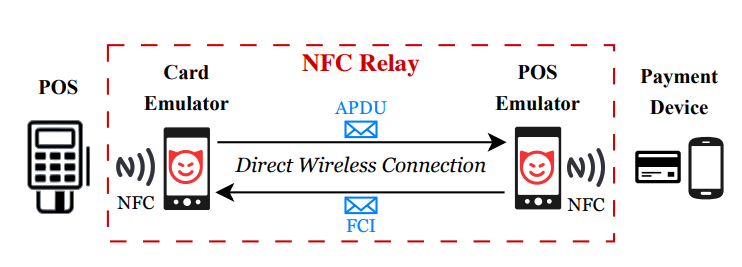
The relay itself is two NFC-capable Android phones running custom software over Wi-Fi: one emulates a card, one emulates a terminal. Each communication round trip added roughly 20 milliseconds for relay alone and about 50 milliseconds with the date modification, keeping the per-transaction average around 415 milliseconds, within Visa’s 500-millisecond command limit.
None of the test hardware used EMV’s optional Relay Resistance Protocol, which would have detected the added latency by bounding permissible response times.
Mastercard, American Express, and Discover all blocked the attack. Mastercard’s terminal checks consistency between the two expiry representations during record parsing and treats a mismatch as a card data error. American Express binds the expiration date into the data covered by offline authentication, so a modified value produces a hash mismatch. Discover’s kernel wraps the modified transaction objects into the verified transaction hash, and those also failed. Visa’s Kernel 3 does none of these things.
The outcome also depended on the issuing bank. The researchers tested three banks with expired and replaced physical Visa cards and found three distinct policies, not a clean pass or fail split. Bank A accepted the modified transactions at $1.00, $100.00, and $500.00 in the lab, and completed purchases of $2.79 at a retail merchant and $3.19 at a grocery merchant on campus. Bank A also accepted transactions from both the expired original card and its replacement against the same account simultaneously, a separate finding that Anwar described as alarming. Bank B detected the modification but still accepted some transactions. A third bank tested on Discover’s kernel detected the edit and declined; however, it also showed the simultaneous-card problem without any modification at all.
There is another finding that makes the issue more serious. Researchers changed the Consumer Device Cardholder Verification Method flag at five US banks, and the transactions worked at most of them. This flag controls how the terminal verifies the cardholder, and attackers can change it because the payment data can be modified while it travels between the card and the terminal.
There is also another problem with Kernel 3. It sends the issuer a Terminal Verification Results value filled with zeros. This means the bank cannot tell whether the terminal checked the card’s expiry date or whether that check failed. The bank must therefore approve the transaction without seeing what the terminal actually detected.
“Across all tests, the dominant factors that determine attack success or failure are: (i) the EMV kernel in use and whether expiry data fields are cryptographically bound to authenticated protocol outputs; (ii) issuer-side lifecycle enforcement, especially whether authorization is tied only to the active account and PAN or also to the specific card instrument and expiration date; and (iii) whether terminal-side validation results are visible to the issuer via TVR. In contrast, transaction amount1 , merchant category, and POS terminal brand did not independently determine the transaction outcome.” continues the paper.
The researchers disclosed the findings to Visa in May 2025 and followed up in December 2025. The paper records that Visa acknowledged the report, said it passed initial triage, and indicated it was undergoing reproduction by Visa’s red team. No CVE has been assigned. Neither Visa nor any of the notified banks confirmed any mitigation as of the paper’s acceptance. The Register asked Visa for comment and received no response.
The countermeasures the paper proposes sit at the kernel, terminal, and issuer layers: bind the expiry date cryptographically to an issuer-verifiable signature, require terminals to compare both expiry representations and make mismatches visible to the issuer, and have issuers authorize against the PAN-and-expiry combination rather than the PAN alone. For cardholders, the researchers recommend destroying the chip and magnetic stripe of expired cards rather than discarding them intact. Given that the attack requires only the expired physical card or sustained NFC proximity to it, that guidance is now slightly less hypothetical than it was before this paper.
Follow me on Twitter: @securityaffairs and Facebook and Mastodon
(SecurityAffairs – hacking, Visa)