Pierluigi Paganini
 August 12, 2026

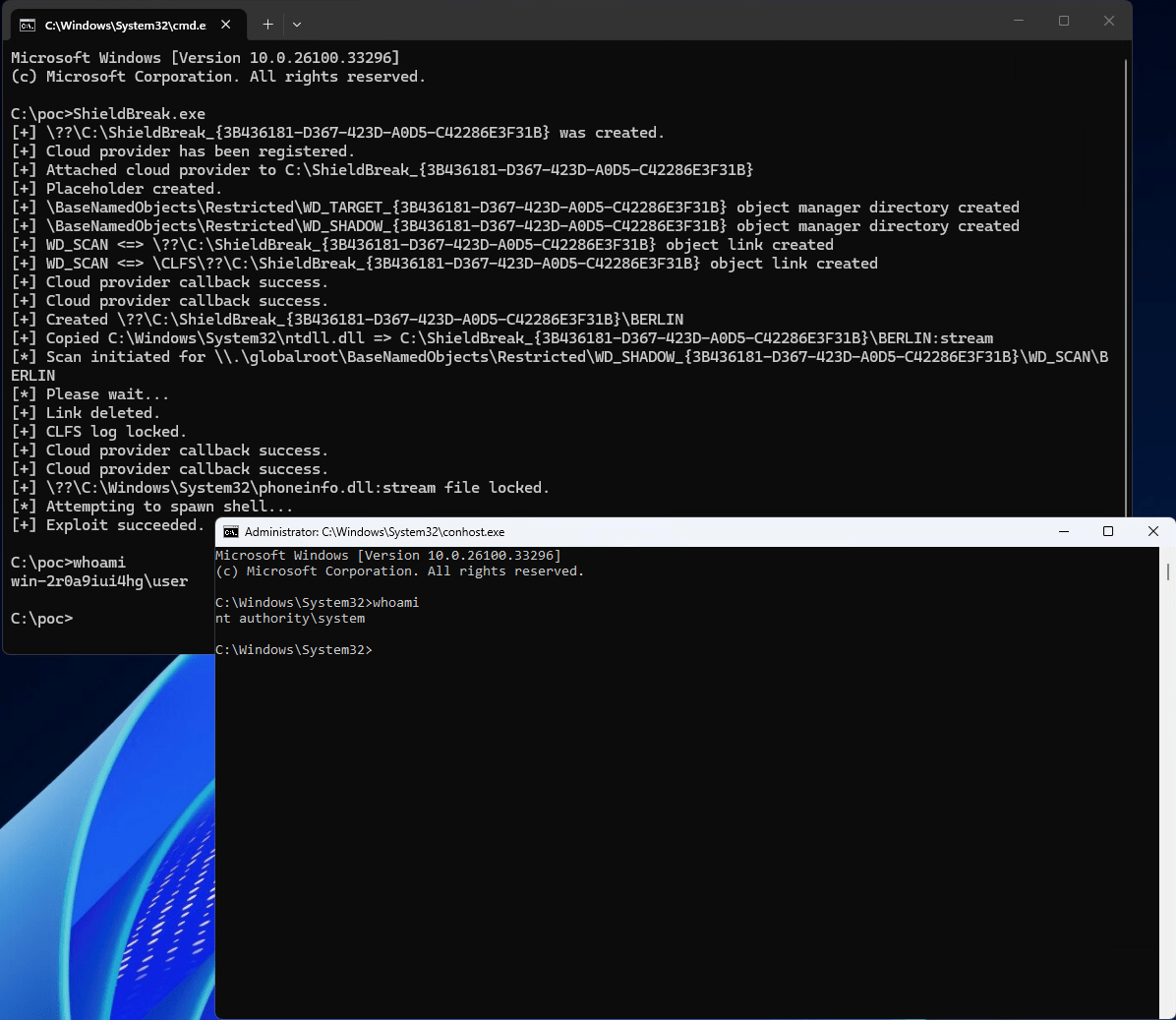
Security researcher Chaotic Eclipse, also known as INFINITE NIGHTMARE, MSNightmare and Nightmare-Eclipse, released a PoC for ShieldBreak, a Microsoft Defender zero-day. The flaw bypasses the patch for CVE-2026-50656 (RoguePlanet), a race condition that can allow attackers to spawn a SYSTEM-level shell. Successful exploitation could enable arbitrary code execution and other unauthorized actions on affected Windows systems.
“Microsoft has failed to properly patch the RoguePlanet vulnerability CVE-2026-50656, this PoC demonstrates a full patch bypass.” said Chaotic Eclipse. “The PoC was tested in the latest version of windows 11 25h2 (+Canary channel) and windows server 2025, the PoC also have a 100% success rate. Please note that Windows 10 (and respective server editions) are not currently supported, they are however vulnerable to ShieldBreak as well.”
In early July, Microsoft released security updates for RoguePlanet, a vulnerability tracked as CVE-2026-50656 (CVSS score of 7.8) affecting the Malware Protection Engine used by Defender. The Microsoft Malware Protection Engine (mpengine.dll) powers Defender’s malware scanning, detection, and removal functions.
The flaw is a local privilege escalation issue that could allow an attacker with access to a system to obtain higher privileges and potentially compromise security controls.
In mid-June, Microsoft acknowledged the RoguePlanet zero-day affecting Microsoft Defender and stated it is aware of the issue and was actively developing a security update to address the flaw and protect affected systems.
A week before, the security researcher Chaotic Eclipse published a new proof-of-concept exploit for a RoguePlanet. The flaw relies on a race condition that can provide attackers with SYSTEM-level privileges, allowing them to execute code with the highest permissions. The exploit was successfully tested on fully updated Windows 10 and Windows 11 systems running the June 2026 Patch Tuesday updates, showing that patched systems may still be vulnerable.
Now Chaotic Eclipse claims ShieldBreak fully bypasses Microsoft’s CVE-2026-50656 patch, while Defender may also leak 8 bytes of data under certain conditions.
The researcher tested the PoC on Windows 11 25H2 and Windows Server 2025 with a 100% success rate. Windows 10 is also vulnerable, though not currently supported by the PoC.
In May, the researcher disclosed two other Windows zero-day vulnerabilities named YellowKey and GreenPlasma. The flaws affect BitLocker and the Windows Collaborative Translation Framework (CTFMON). YellowKey could allow attackers to bypass BitLocker protections, while GreenPlasma enables privilege escalation. The researcher previously disclosed three Microsoft Defender vulnerabilities.
The researcher criticized Microsoft for revoking access to their MSRC account, rejecting reports, and failing to provide compensation.
At the end of May, Microsoft’s Security Response Center called the zero-day dumps irresponsible.
“In recent weeks several zero-day vulnerabilities have been publicly disclosed.” reads the report published by Microsoft. “The details of these vulnerabilities were not shared with Microsoft prior to release, and the disclosures put our customers at unnecessary risk.”
The company said its security teams have been working around the clock since the disclosures to understand the impact, build patches, and protect customers from attackers who picked up the published exploit code and ran with it.
Microsoft’s post is essentially a public defense of Coordinated Vulnerability Disclosure, the standard practice where a researcher notifies a vendor privately, gives them time to fix the issue, and then goes public. Microsoft says it works with hundreds of researchers this way every year, compensating them through bug bounty programs and crediting them publicly.
“This partnership allows us to make updates to impacted services before proof-of-concept code can make it into the hands of bad actors.” continues the report. “The vulnerabilities known as RedSun, UnDefend, BlueHammer, YellowKey, GreenPlasma, and MiniPlasma were not responsibly disclosed.”
The implication is clear: when someone skips that step, real people get attacked with real tools built from the published research.
In July, just hours after Microsoft’s July 2026 Patch Tuesday, Chaotic Eclipse, published a new Windows zero-day proof-of-concept called LegacyHive. This time, the target is the Windows User Profile Service (ProfSvc), and unlike the hundreds of vulnerabilities Microsoft fixed this month, this one currently has no CVE, no advisory, and no security update.
LegacyHive is a local privilege escalation vulnerability. An attacker who already has code execution as a standard user can abuse the User Profile Service to load another user’s registry hive, potentially that of a local administrator, under their own profile.
At the end of May, Microsoft’s Security Response Center called the zero-day dumps irresponsible.
“In recent weeks several zero-day vulnerabilities have been publicly disclosed.” reads the report published by Microsoft. “The details of these vulnerabilities were not shared with Microsoft prior to release, and the disclosures put our customers at unnecessary risk.”
The company said its security teams have been working around the clock since the disclosures to understand the impact, build patches, and protect customers from attackers who picked up the published exploit code and ran with it.
Microsoft’s post is essentially a public defense of Coordinated Vulnerability Disclosure, the standard practice where a researcher notifies a vendor privately, gives them time to fix the issue, and then goes public. Microsoft says it works with hundreds of researchers this way every year, compensating them through bug bounty programs and crediting them publicly.
“This partnership allows us to make updates to impacted services before proof-of-concept code can make it into the hands of bad actors.” continues the report. “The vulnerabilities known as RedSun, UnDefend, BlueHammer, YellowKey, GreenPlasma, and MiniPlasma were not responsibly disclosed.”
The implication is clear: when someone skips that step, real people get attacked with real tools built from the published research.
Follow me on Twitter: @securityaffairs and Facebook and Mastodon
(SecurityAffairs – hacking, ShieldBreak)