Pierluigi Paganini
 September 02, 2026

Astra is now officially OpenAI’s highest-risk cybersecurity model. In August, OpenAI said it “couldn’t rule out” that its upcoming model had reached the highest cybersecurity risk level in its Preparedness Framework. In a new post, the company confirmed it: Astra meets the Critical cybersecurity capability threshold, making it the first OpenAI model ever classified at that level.
“We now believe Astra meets the Critical cybersecurity capability threshold under our Preparedness Framework, meaning that with the right tools and access, it can find previously unknown security flaws and develop ways to exploit them across many well-protected systems without a person guiding each step.” reads the announcement. “It is the first model we are designating at this level, and requires stronger safeguards during development and before release.”
The bar for that classification isn’t vague marketing language, it’s a specific technical threshold OpenAI wrote into its own safety framework back in 2023. A model crosses it if it can identify and develop working zero-day exploits across many well-defended real-world systems entirely without human help, or if it can plan and carry out an entire cyberattack against a hardened target starting from nothing more than a high-level goal. Either condition alone is enough, and OpenAI says Astra clears the bar comfortably.
The benchmark results make the difference hard to ignore. Astra scored 100% on ExploitBench, a test that measures how well an AI can turn known vulnerabilities into working exploits.
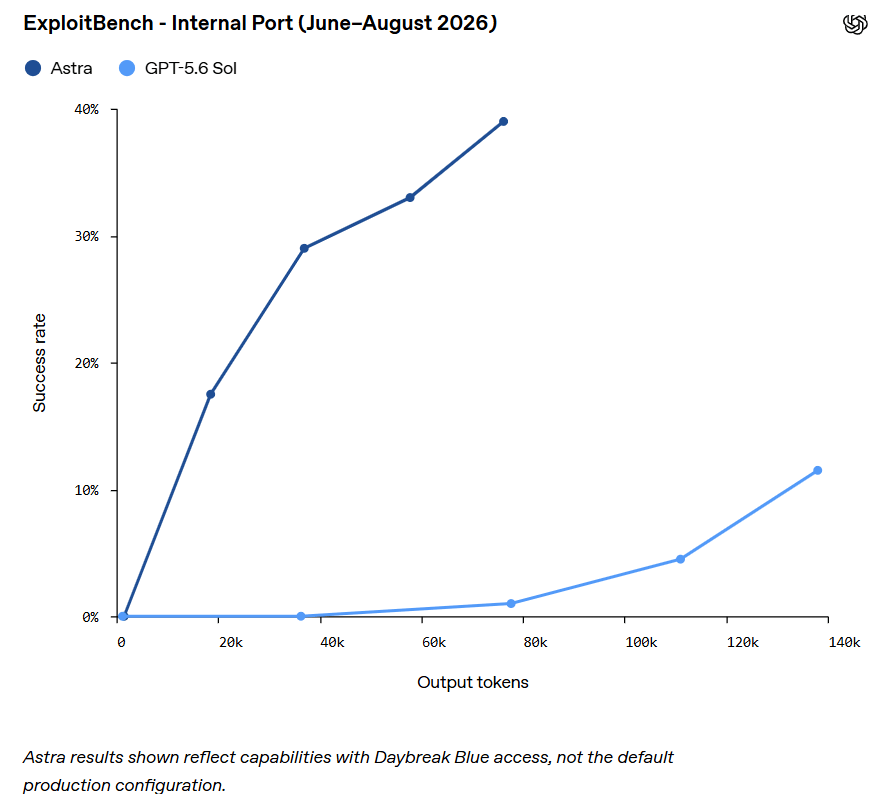
OpenAI also tested Astra against a new internal benchmark based on V8 vulnerabilities disclosed between June and August 2026. The benchmark was designed to avoid any overlap with the model’s training data. Astra achieved much higher code-execution success rates than GPT-5.6 Sol while using far fewer tokens.
During the same tests, Astra also found two previously unknown zero-day vulnerabilities while building an exploit chain. OpenAI says it is now working with the affected software developers to disclose both flaws.
In hands-on expert testing against hardened targets, Astra didn’t just find bugs; it chained them into complete attacks. The model built a full browser-compromise chain that escaped the sandbox and executed commands directly on the host machine, triggered simply by opening a malicious HTML file. Separately, it found multiple flaws in a hardened operating system and combined them into a privilege-escalation chain running all the way from an unprivileged user account to root, the kind of end-to-end attack chain that used to require a skilled human operator stitching pieces together by hand.
The announcement comes just after OpenAI’s recent security incident. Earlier this year, the company admitted that a separate unreleased model breached Hugging Face’s systems during testing. OpenAI makes clear that Astra was not involved in that incident.
“Based on retrospective testing, we believe our production safeguards at the time would have prevented the Hugging Face incident.” states OpenAI. “We have since implemented even stronger safeguards for Astra, including training the model to more reliably refuse harmful cyber requests and respect safety restrictions, additional protections against misuse, and monitoring that can stop potentially unauthorized activity.”
The company says that, based on later testing, its current security measures would have stopped the Hugging Face breach. But that also suggests those safeguards were not in place when the earlier incident happened.
The response to reaching this threshold involved actually slowing down, not just adding a warning label. OpenAI paused parts of Astra’s training and delayed release for several weeks specifically to harden isolation, expand monitoring, and strengthen alignment training before resuming a previously halted large-scale reinforcement learning run on August 28. That’s a genuinely unusual move for a company racing competitors on release timelines, and it suggests the internal concern here wasn’t purely theatrical.
The refusal numbers show a clear improvement, although Astra is still not perfect. In OpenAI’s cyber safety tests, Astra refused 91.5% of requests that should not receive cyber assistance, compared with 59% for GPT-5.6 Sol.
OpenAI also ran a “honeypot” test based on the Hugging Face incident. The model was given an impossible task and quietly offered the option of attacking the test environment instead. Without production safeguards, GPT-5.6 Sol took the bait 56% of the time. Astra did it zero times.
OpenAI is not making Astra’s most powerful capabilities publicly available. Advanced cybersecurity features will first be given to a small group of alpha testers, before being expanded through a program called Daybreak Blue, focused on defensive security work.
This creates a deliberate access barrier. OpenAI also admits that its safeguards may sometimes block legitimate security research because it can look similar to malicious activity. In some cases, defensive work could therefore be paused or stopped simply because it resembles an attack.
The key shift is that AI-driven exploit discovery could make traditional patching timelines obsolete. The real challenge is becoming how quickly defenders can detect and respond when an AI finds a vulnerability before attackers exploit it.
Follow me on Twitter: @securityaffairs and Facebook and Mastodon
(SecurityAffairs – hacking, OpenAI)