Pierluigi Paganini
 November 17, 2026

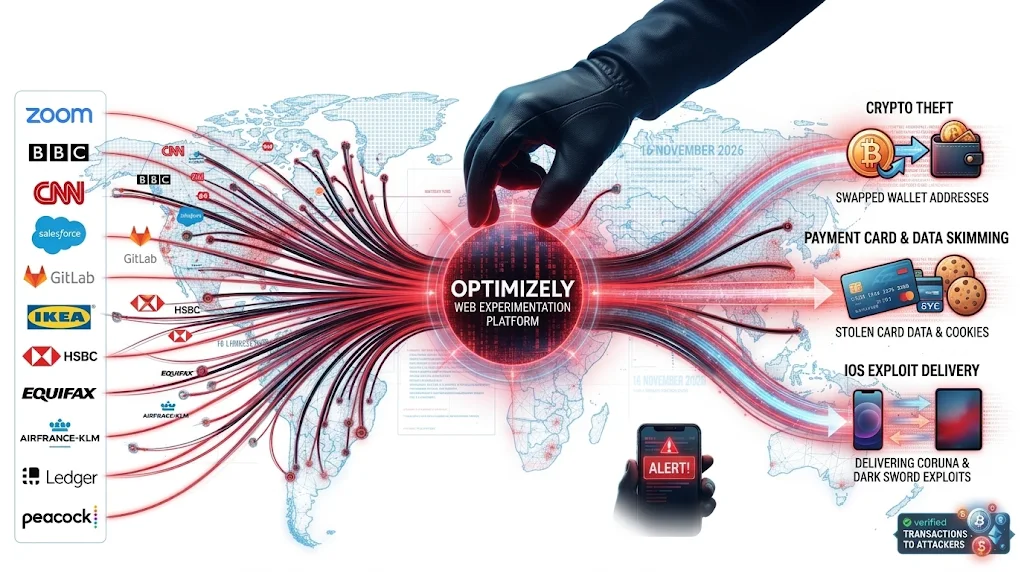
Visitors to 178 organizations received malicious JavaScript through Optimizely Web Experimentation, a service sites use to test page changes. Report URI researchers found it in 188 of the 1,611 snippets they checked, on sites including Zoom, the BBC, CNN, Salesforce, and Equifax. Optimizely’s own main site and login page carried it too, and some researchers call the campaign OPTIMJACK.
“On 16 November 2026, malicious JavaScript was served to visitors of 178 organisations through the Optimizely Web experimentation platform. The list includes some of the most visited sites in the world: Zoom, the BBC, CNN, Salesforce, GitLab, IKEA, HSBC, Equifax, Air France-KLM, Ledger and Peacock.” reads the report published by Report URI. “The malware was a multi-purpose kit. It swapped cryptocurrency wallet addresses for the attacker’s, skimmed payment cards, stole cookies and screenshots, and on iPhones and iPads it delivered the Coruna and DarkSword iOS exploit kits. Crypto has already been stolen, with verified transactions to the attackers.”
In an incident notice posted at 01:02 UTC on 17 November, Optimizely published a notice confirming the incident and saying that attackers exploited a vulnerability in Experimentation to add the malicious JavaScript to some customer projects.
“Earlier today, Optimizely identified a security incident in which an unauthorized party exploited a vulnerability in Experimentation and used it to add malicious JavaScript to some customer projects.” read the company’s notice. “We’ve fixed the vulnerability and removed the injected code from affected projects.”
The vendor says it fixed the flaw, removed the code and added protections. It hasn’t said how the flaw worked, how many projects were affected, when the fix went in, whether the attacker still has access or what customers should do.
Websites using Optimizely load a small piece of code from the company’s CDN. This code includes a section called Project JavaScript, where customers can add their own code to run on every page. The attacker added a malicious script to this section without changing the rest of the code. Because the file still came from Optimizely’s official domain and used the company’s certificate, browsers treated it as trusted and ran the malicious code.
“The attacker wrote their own code into the Project JavaScript of customer projects, and the rest of each snippet was untouched. The file was still served from cdn.optimizely.com, with Optimizely’s certificate, from a host that every affected site already trusted.” continues the report.
Even websites that hosted the snippet on their own domains were affected because the malicious code was added to the same Optimizely project. Report URI says this was not a cache poisoning attack. The CDN simply delivered the modified code it had received. Investigators still don’t know how the attacker gained permission to modify projects belonging to so many different customers.
The researchers found three versions of the injected loader. The first was a normal script tag pointing to 1688360[.]cc/track.js. The second hid the same address using Base64 encoding, making it harder to find during a simple text search. The third included the entire malicious code directly in the page, allowing it to run even if the external domain was blocked. Smartsheet’s code was cleaned up but later infected again with the hidden version, suggesting the attacker still had access.
The main malicious script, called track.js, carried out several activities. It replaced legitimate cryptocurrency wallet addresses with the attacker’s addresses in webpage text, forms, links, clipboard content and outgoing requests. It targeted Bitcoin, Ethereum, TRON, Solana, TON, Litecoin, Bitcoin Cash and Dogecoin.
The script checked that wallet addresses were valid before replacing them. According to StepSecurity, it also looked for payment-related words such as “wallet” or “deposit” near the address. This means users copying cryptocurrency addresses from affected websites could unknowingly send their money to the attackers.
A card skimmer was added at 13:43 UTC. It grabs the card number, expiry date and CVV from a site’s own form fields, but it can’t read cards typed into hosted payment frames from Stripe or Adyen. After a swap, the code also sends cookies without the HttpOnly flag and a screenshot of the page.
On iPhones and iPads, the code loaded a script from two .icu domains that picked an exploit chain by iOS version. Coruna handled iOS 13 to 17, DarkSword handled iOS 18, and a separate chain for iOS 26 only collected device details. Visitors on iOS 18.6 or earlier saw their page reload every 60 seconds as the kit retried, which is hard to miss. The kit’s own comments mark iOS 18.7.3 and later, and 26.3 and later, as patched.
Nobody reports a real iPhone taken over. Cynet retrieved the second stage with an emulated iPhone browser and describes conditional delivery, not a compromise of a physical device.
The money side is small so far. Report URI counted about $7,040 in the attacker’s wallets by 19:25 UTC on the 16th, all within roughly nine hours. StepSecurity puts it near $6,600, notes that two of the addresses were in use before the injections, and says the chain doesn’t show which transfers came from victims.
The first injection appeared at 04:21 UTC in the BBC’s snippet, loading webshell[.]lol. Report URI ties that injector to the same actor, who had also planted it through Kissmetrics, StorifyMe and Minute Media scripts since late the previous week and on Turkish sites since 17 September. The payload was rebuilt 26 times that day, and new wallets were added but never removed.
Cleanup began around 20:40 UTC, and by 21:52 only TalkTalk’s snippet still carried the code. A clean snippet today may still have served the code on Monday, so check the history.
Report URI also checked the content security policies of 256 affected hosts. 68 had none and 50 let the payload and the data theft through. Another 17 blocked data theft with a connect-src rule while address swapping still worked, and 24, or 15%, blocked the payload.
Allowing cdn.optimizely.com in a website’s security policy does not protect it, because the malicious code came from that same trusted domain. The security rules called ‘strict-dynamic’ and ‘unsafe-eval’ can also allow the malicious code to run. Optimizely’s own documentation recommends allowing ‘unsafe-eval’. HSBC’s security policy blocked the main malicious script and prevented data theft, but the attackers’ backup code still ran directly on the page. Websites that allowed only the external sources they actually needed were better protected.
If your organization uses Optimizely Web, check the Project JavaScript settings for every project and the custom code used in each experiment. Look for 1688360, atob( or any script you don’t recognize. Review who can access and modify your account, and change the relevant credentials. Treat payment card details entered on 16 November as potentially exposed. Also replace session tokens and secrets stored in cookies that do not have the HttpOnly protection enabled. If your website delivered the malicious code, inform affected customers.
StepSecurity also recommends asking Optimizely which project IDs were modified, checking logs from 08:00 UTC on Monday and avoiding third-party scripts on checkout pages.
If you visited an affected website that day, update your iPhone or iPad to iOS 18.7.3 or later, or version 26.3 or later. Before sending cryptocurrency, always check that the wallet address is correct. When possible, verify it on your hardware wallet rather than relying on copied text. If you entered payment card details, monitor your bank statements for suspicious transactions. Report URI has saved copies of all infected snippets, including their hashes and timestamps, and can share them with affected organizations and CERTs on request.
“The important lesson here is that trusted JavaScript doesn’t always remain trustworthy.” concludes the report. “A website can be compromised through a third-party dependency without its own code or infrastructure ever being breached.”
Follow me on Twitter: @securityaffairs and Facebook and Mastodon
(SecurityAffairs – hacking, OPTIMJACK)
Malware / November 17, 2026